
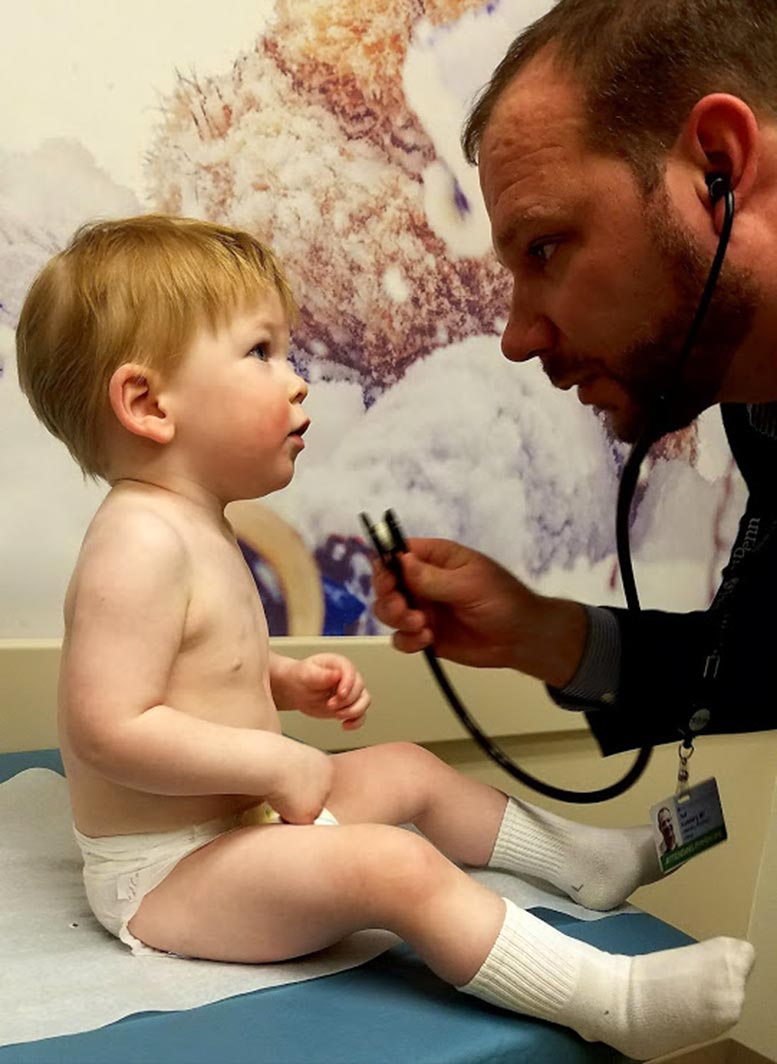
CHOP team treated patient with the condition, known as PU.MA, thanks to a bone marrow donation from the patient’s older brother.
When Luke Terrio was about seven months old, his mother began to realize something was off. He had constant ear infections, developed red spots on his face, and was tired all the time. His development stagnated, and the antibiotics given to treat his frequent infections stopped working. His primary care doctor at Children’s Hospital of Philadelphia (CHOP) ordered a series of blood tests and quickly realized something was wrong: Luke had no antibodies.
At first, the CHOP specialists treating Luke thought he might have X-linked agammaglobulinemia (XLA), a rare immunodeficiency syndrome seen in children. However, as the CHOP research team continued investigating Luke’s case, they realized Luke’s condition was unlike any disease described before.
Using whole-exome sequencing to scan Luke’s DNA, CHOP researchers discovered the genetic mutation responsible for his condition, which prevents Luke and patients like him from making B cells and antibodies to fight infections. The study describing Luke’s condition, which CHOP researchers named PU.1 Mutated agammaglobulinemia (PU.MA), was published today (May 5, 2021) in the Journal of Experimental Medicine.
“It can be pretty scary for a family whose child has a mysterious illness,” said Neil D. Romberg, MD, an attending physician with the Division of Allergy and Immunology at CHOP and senior author of the paper. “In this case, science provided an explanation, thanks to numerous departments at CHOP, including the Roberts Individualized Medical Genetics Center, the Center for Spatial and Functional Genomics, and the Cancer Center. Understanding the cause of Luke’s condition absolutely helped us know what direction to take his therapy.”
“I was so impressed with how all of the specialists at CHOP worked together as a team, even though they specialized in different areas,” said Luke’s mother, Michelle. “They knew something was wrong with Luke, and they didn’t stop digging until they figured it out.”
Figuring Out the “Why”
To pinpoint the gene at fault, CHOP researchers compared whole exome sequences from 30 patients across the globe who were born without B lymphocytes, the cells which produce antibodies. From the larger group, they identified six patients, including Luke, who had a mutation in a gene called SPI1, which encodes the PU.1 protein. PU.1 helps B lymphocytes developing in bone marrow to open up “doors” in their chromatin, a type of tightly packed DNA. Without PU.1, those doors remain shut, and the B cells never form. The six PU.MA patients, who ranged in age from 15 months to 37 years, each had different SPI1 mutations but shared insufficient levels of PU.1, absent B cells, and, consequently, zero antibodies.
To validate the roles of SPI1 and PU.1, the researchers used CRISPR to reconstitute the condition in vitro. Using donated cord blood of patients who lacked SPI1 mutations, the researchers employed CRISPR to edit the patients’ SPI1 mutations into the donated cord blood genes. After culturing the cells for six weeks and sequencing the cells that survived, they found B cells were specifically intolerant of PU.1 changes.
Treatment Without a Playbook
Because Luke’s condition was entirely new, there was no playbook for his family or his medical team to follow. After consulting with the research team, the family decided to proceed with a bone marrow transplant in the hope that the procedure would help him make his own B cells and antibodies. Soon they discovered they had a perfect match living under their own roof: Luke’s older brother, Jack.
At three and a half years of age, Jack, who has high-functioning autism, donated his bone marrow to Luke. The transplant was successful at getting Luke to produce his own B cells. Until those B cells are able to create enough protective antibodies by themselves, Luke continues to receive infection protection from the antibody infusions he receives every two weeks.
“We call them his ninjas,” said Michelle describing antibodies. “We tell him that he doesn’t make his own ninjas, so he needs these ninja infusions to fight the germs and keep him safe.”
Thanks to those “ninjas” and his brother’s gift of bone marrow, Luke is now an energetic 4-year-old boy who loves Transformers, fire trucks, and his balance bike. Before his bone marrow transplant and the infusions, he needed naproxen twice a day for his joint pain, required leg braces to straighten his legs, and would lie on the floor exhausted tire after 10 minutes of activity. Now, he always seems to be running, often with his dog Charlie chasing behind him.
“Knowing the source of the problem removed the boogeyman for the Terrios and allowed them to move their lives forward,” Romberg said. “Figuring out Luke’s case not only helped guide his therapy and gave answers to others suffering with this rare condition — in some cases for years — but also opened the door to learning more about the effects of PU.1 on a variety of more common human diseases and conditions.”
Reference: “Constrained chromatin accessibility in PU.1-mutated agammaglobulinemia patients” by Carole Le Coz, David N. Nguyen, Chun Su, Brian E. Nolan, Amanda V. Albrecht, Suela Xhani, Di Sun, Benjamin Demaree, Piyush Pillarisetti, Caroline Khanna, Francis Wright, Peixin Amy Chen, Samuel Yoon, Amy L. Stiegler, Kelly Maurer, James P. Garifallou, Amy Rymaszewski, Steven H. Kroft, Timothy S. Olson, Alix E. Seif, Gerald Wertheim, Struan F.A. Grant, Linda T. Vo, Jennifer M. Puck, Kathleen E. Sullivan, John M. Routes, Viktoria Zakharova, Anna Shcherbina, Anna Mukhina, Natasha L. Rudy, Anna C.E. Hurst, T. Prescott Atkinson, Titus J. Boggon, Hakon Hakonarson, Adam R. Abate, Joud Hajjar, Sarah K. Nicholas, James R. Lupski, James Verbsky, Ivan K. Chinn, Michael V. Gonzalez, Andrew D. Wells, Alex Marson, Gregory M.K. Poon and Neil Romberg, 5 May 2021, Journal of Experimental Medicine.
DOI: 10.1084/jem.20201750
Never miss a breakthrough: Join the SciTechDaily newsletter.
Follow us on Google and Google News.
2 Comments
Bring this up for discussion again when the cases rise over one.
So the “vaccine” is now showing its symptoms in the population